
Your Cart is Empty
How a Mother Shapes Who Her Children Become
24 Apr, 2026 5
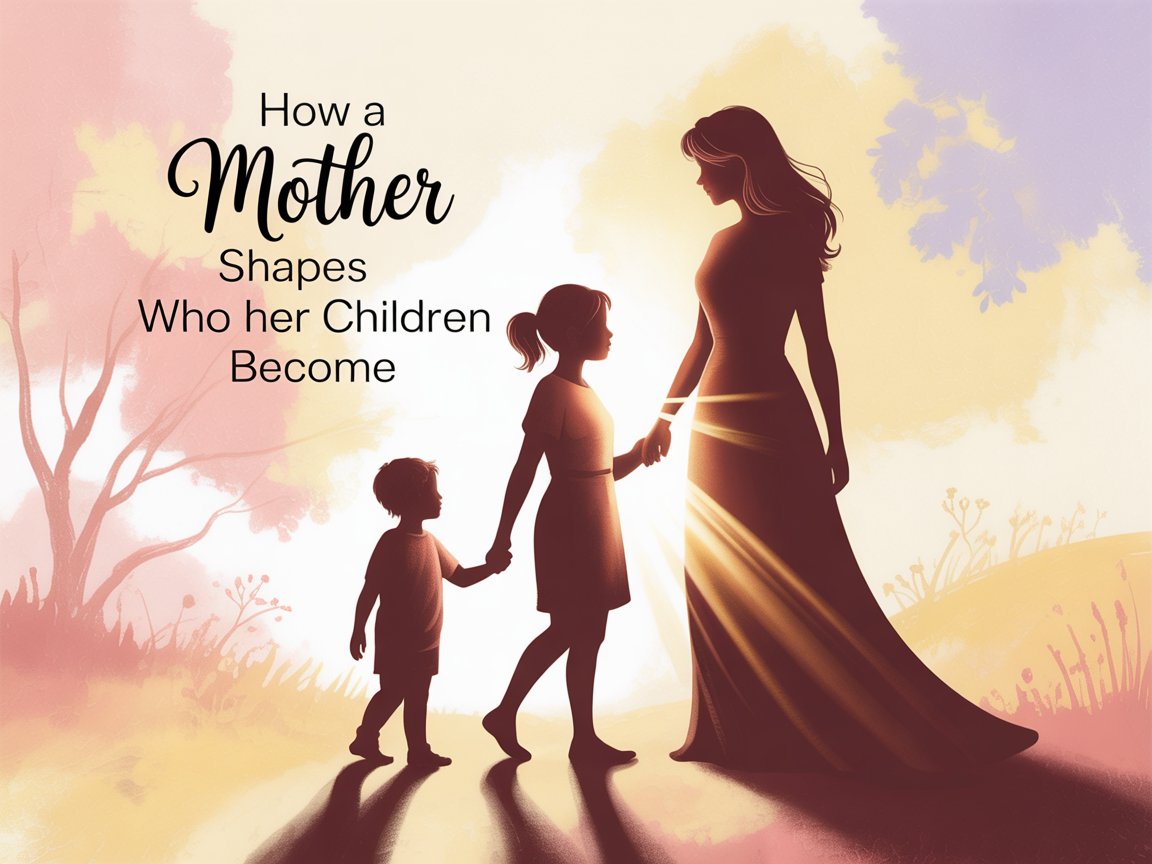
Long before a child has words, they are learning.
They are watching the way the person closest to them moves through the world. How she responds when something goes wrong. Whether she speaks kindly to strangers. Whether she apologizes when she makes a mistake. Whether she laughs easily, loves openly, holds herself together under pressure, or falls apart and finds her way back.
They are taking notes on all of it, in the wordless and permanent way that early childhood allows. And slowly, without either of them fully realizing it, the child begins to become a reflection of what they have seen.
A mother is many things. But perhaps most profoundly, she is the first mirror a child looks into to understand who they might be.
This is the story of that influence — quiet, constant, and more lasting than most of us ever stop to fully consider.
The First Voice They Hear Becomes the Voice Inside Their Head
Before a child develops their own inner voice — the one they will carry through every decision, every moment of self-doubt, every crisis and quiet triumph for the rest of their lives — they borrow one.
They borrow their mother's.
Not always her literal words, though those matter too. They borrow her tone. The way she spoke to them when they were small. Whether that voice was warm or cold, patient or rushed, encouraging or critical. Whether it said you can figure this out or why can't you just get it right.
Research in developmental psychology has consistently shown that the quality of early maternal communication shapes a child's internal narrative in ways that persist well into adulthood. Children who were spoken to gently and with emotional warmth tend to develop a more compassionate relationship with themselves. Children who were criticized harshly — even with good intentions — often carry that critical voice inward for decades, sometimes for life.
This does not mean perfection. No mother speaks with perfect patience every day. What matters is the overall tone, the weather of the relationship, the feeling a child carries when they think about home.
The voice you give your child will become the voice they give themselves. That is one of the most important things a mother ever does, and she often does it without knowing it is happening at all.
She Teaches Them What Love Looks Like
A child's first understanding of love is not abstract. It is entirely concrete, built from observation, from the specific texture of how love was practiced in the home where they grew up.
If a mother's love was consistent — present on the ordinary days, not just the celebrations — the child learns that love is reliable. That it does not require earning. That it will be there tomorrow in roughly the same shape it was today.
If a mother's love was conditional — withheld when the child disappointed, restored when they performed well — the child learns something different. They learn that love is something to be won and lost, something precarious, something that requires constant management. And they carry that understanding into every relationship they form for the rest of their lives.
This is why the way a mother loves matters as much as the fact that she loves. The child is not just receiving affection. They are forming a model of what affection is, how it works, and what they should expect from the people who say they love them.
Mothers who love with consistency and warmth — imperfectly, humanly, but reliably — give their children an internal baseline for relationships that will serve them for decades. That baseline is one of the most valuable things a person can carry into adulthood.
Her Relationship With Herself Becomes Their Template
This is the part that surprises most mothers when they first encounter it. Because it means the influence runs deeper than behavior, deeper than words. It reaches into the way she sees herself.
Children watch how their mother treats herself. Whether she speaks about her own body with kindness or contempt. Whether she allows herself rest or runs herself into the ground and calls it virtue. Whether she pursues things that matter to her or quietly abandons her own needs generation after generation.
A mother who says I am not smart enough in front of her daughter is teaching her daughter something about what women like them are allowed to believe about themselves. A mother who tolerates being spoken to poorly is showing her children what they should expect to tolerate. A mother who never asks for help is teaching her children that needing help is something to be ashamed of.
None of this is intentional. Most of it is unconscious, passed down from her own mother, and from her mother before that.
But the chain can be broken. And it most often breaks at the point of awareness — the moment a mother decides that the way she was taught to see herself is not the only way, and that she owes her children a different example.
A mother who respects herself teaches her children self-respect. A mother who sets boundaries teaches her children that their needs are worth protecting. A mother who pursues her own growth, even imperfectly, teaches her children that it is never too late to become more fully yourself.
She does not have to be perfect. She has to be honest. She has to be trying.
She Shows Them How to Handle Hard Things
Life will be difficult. There is no version of a childhood, no matter how carefully protected, that does not eventually encounter loss, failure, disappointment, and grief. The question is not whether hard things will come. The question is whether a child will know how to meet them.
Much of that capacity is built by watching their mother.
A mother who falls apart completely under pressure and never recovers teaches her children that hard things are unsurvivable. A mother who pretends nothing is hard teaches her children to suppress and deny rather than process. But a mother who lets her children see her struggle, and also lets them see her find her footing again — who says this is hard, and I am sad, and I will be okay — gives her children something irreplaceable.
She gives them the model of resilience. Not the Instagram version of resilience, with the clean ending and the lesson learned. The real version: the one that is slow, unglamorous, uncertain, and ultimately possible.
Children who see their mothers navigate difficulty with honesty and eventual steadiness develop stronger emotional regulation skills. They are more likely to ask for help. They are more likely to believe that painful things can be survived. They are more likely to get back up.
That capacity — to get back up — is one of the most important things a person can have. And for many people, they first saw it modeled by their mother.
Her Curiosity, Her Passions, Her Way of Seeing the World
It is not only the hard things that shape a child. It is the texture of their mother's everyday aliveness.
A mother who reads shapes children who understand that the world is larger than what they can directly see. A mother who cooks with care shapes children who understand that ordinary things can be done with love and intention. A mother who notices beauty — in a particular light, in a stranger's kindness, in the right word in the right sentence — teaches her children to look for it too.
A mother's passions are among the most quietly influential forces in a child's development. Not because the child will necessarily share them, but because watching someone pursue what they love with genuine engagement teaches something fundamental about what a life can contain.
Children who grow up in homes where curiosity was modeled are more likely to stay curious themselves. Children who grew up watching their mothers care about the world — its people, its injustices, its small wonders — are more likely to become people who care about those things too.
What a mother finds worth paying attention to becomes, in some measure, what her child learns to see.
The Apology She Makes and the One She Never Does
There is a particular kind of mother whose children grow up not quite sure where they stand. Who can read a room perfectly before they walk in. Who are hypervigilant about moods, quick to smooth over tension, deeply uncomfortable with conflict — and who often do not understand why.
Much of that sensitivity was shaped in childhood, by growing up in a home where accountability was absent or inconsistent. Where mistakes were never acknowledged. Where the atmosphere could shift without warning and no one explained why.
The mother who apologizes to her child — genuinely, without immediately redirecting the apology back toward herself — does something quietly extraordinary. She teaches her child that adults make mistakes and own them. That relationships can absorb rupture and repair. That love does not require pretending.
The mother who never apologizes, or who apologizes in ways that are really performances of being wronged, teaches the opposite. She teaches the child to doubt their own perception. To wonder if what they felt was real. To accept relationships in which their experience is never quite acknowledged.
The willingness to be accountable — to say I got that wrong, I am sorry — is one of the most profound gifts a mother can model for her children. It teaches them how to love imperfectly and honestly. Which is, in the end, the only way anyone actually loves.
She Does Not Have to Be Perfect to Be Enough
If you are a mother reading this, and this list has started to feel like an inventory of everything you might be getting wrong — stop.
That is not what this is.
This is an acknowledgment of how much you matter. Not because you are perfect, but because you are present. Because you are trying. Because the fact that you care about your influence on your children is itself a form of that influence.
The children who turn out best are not the children of perfect mothers. They are the children of mothers who were honest with them, who loved them without condition, who showed up imperfectly but consistently, who were willing to grow and change and admit they did not have all the answers.
Perfection would be unrelatable. What your children need from you is not perfection. It is realness. It is you — specifically, with all your history and your contradictions and your ongoing effort to do better — showing up and trying.
That is enough. More than enough. It is, in fact, everything.
What We Carry Forward
At some point, every person who was loved well by their mother will find themselves doing something — cooking a certain dish, humming a certain song, pausing to notice something beautiful that others have walked past, responding to a hard moment with more steadiness than they expected — and they will feel it.
The inheritance.
Not of money or property or any tangible thing. But of a way of being in the world. A set of instincts and values and quiet habits of attention that were built, slowly, by watching someone who loved them before they knew what they were.
The influence of a mother does not announce itself. It does not come with a citation or a timestamp. It lives in the way her children eventually treat the people they love, and the way they eventually treat themselves.
It lives in the voice inside their head when things get hard.
It lives in what they find worth noticing, and what they believe they deserve, and how wide their arms open when someone they love needs holding.
It lives, quietly and permanently, in who they become.
Happy Mother's Day, 2026.
To every mother who is shaping someone, in all the ways she may not yet fully see — this day is for you.

Share on Facebook

Share on X

Share on Pinterest
0 Comment(s)