
Your Cart is Empty
Coming Home for Mother's Day — Why the Trip Is Always Worth It
27 Apr, 2026 9
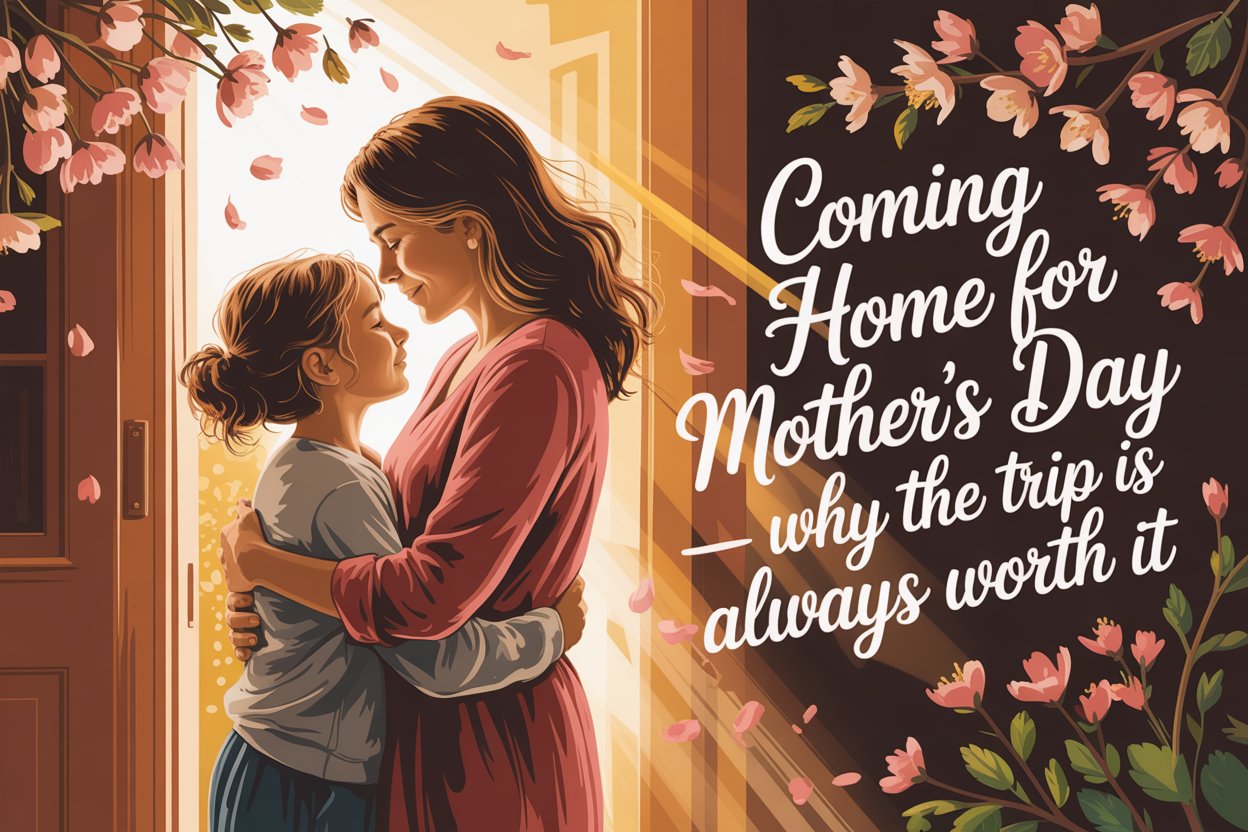
There is a particular kind of tired that only comes from the drive home.
Not the tired of a long work week, or a bad night's sleep, or a day that asked too much of you. This is something softer and older than that. It is the tiredness of someone who has been holding themselves together out in the world for a long time, and who is finally, within a few miles of the place they came from, beginning to let go.
You have not even pulled into the driveway yet. But something in your body already knows where you are.
This is what coming home for Mother's Day feels like. And if you have been on the fence about whether to make the trip this year — whether it is worth the cost, the time, the logistics, the long drive or the early flight — this is for you.
The House That Holds Everything
Every family home has its own particular version of familiar.
The sound the screen door makes. The way the kitchen smells on a Sunday morning. The specific quality of light that comes through the window above the sink in the late afternoon. The chair she always sits in. The coffee mug she has used for so many years that you cannot imagine the kitchen without it.
You stopped noticing these things when you lived there. They were simply the texture of daily life, too ordinary to register.
But when you come back — after months away, after the accumulation of your own separate life in your own separate place — you notice all of it. It hits you the way only familiar things can, with a wave of recognition so complete that it briefly undoes the careful composure of adulthood.
You are home. You did not realize, until right now, how much you needed to be.
And she is standing in the kitchen, having heard the car in the driveway before you even knocked, and the look on her face when she sees you is the same look it has always been — the one that says you are the best thing that has walked through that door in a long time.
That look alone is worth the trip.
What She Does Not Say Out Loud
Your mother will not tell you how much she has been looking forward to this.
She will not tell you that she cleaned the house twice in the week before you arrived. That she bought the specific things she knows you like — the cereal you ate in high school, the brand of juice you mentioned once in passing six months ago that she remembered and found at three different stores before she got it right. That she made your bed with the good sheets and fluffed the pillow the way she knows you prefer it.
She will not tell you that she mentioned you were coming to everyone she talked to this week. That she has thought about what to cook since the moment you confirmed your plans. That the house has felt different in the days leading up to today — more purposeful, more alive, organized around the fact of your arrival.
She will not say any of this. She will just hand you something warm to drink and ask about the traffic and begin moving around the kitchen with the particular efficiency of someone who has been planning this meal in her head for days.
But you should know. You should know all of it.
Because behind the ordinary surface of the morning — the small talk, the comfortable silence, the familiar rhythms of a household you grew up in — there is an enormous amount of love that has been quietly building toward this moment.
You showing up is the gift. You being there, in the house, at the table — that is what she wanted more than anything else you could have brought.
The Meal That Cannot Be Replicated
There will be food.
There is always food. It is one of the oldest languages of maternal love — the preparation of a meal as an act of devotion, as proof of attention, as the most concrete way of saying I thought about you and I wanted you to feel it.
You have eaten in good restaurants. You have learned to cook for yourself, maybe even well. You have eaten food in other people's homes that was technically superior — more refined, more sophisticated, made with more expensive ingredients by people with more formal training.
None of it tastes like this.
What you are tasting is not just the recipe. It is the accumulation of every time she has made this dish before, every occasion it has anchored, every memory attached to the smell of it in the oven or the particular sound it makes in the pan. It is the fact that she made it specifically for you, that she knows you will want seconds, that she has already planned what to send home with you when you leave.
You will eat too much. You will sit at the table longer than you meant to. You will feel, somewhere in the vicinity of your chest, something large and quiet and uncomplicated.
That feeling is called being home. And you cannot order it from anywhere.
The Conversations That Only Happen Here
There is a kind of conversation that only seems to happen in the family home.
Not the scheduled check-in calls, not the group chat messages, not the quick catch-up over FaceTime where someone is always half-distracted and the connection drops twice. Something different. Longer and slower and less directed, the kind of talking that happens when there is no particular reason to stop.
You end up in the kitchen at eleven at night, long after dinner was cleared and everyone said they were going to bed. And somehow two hours pass. You talk about things you have been meaning to say for months. You ask questions you have been carrying quietly. You hear stories you have never heard before — about her own childhood, about the years before you were born, about the version of her that existed before she became your mother.
You realize, not for the first time but more sharply than usual, that she is a full person with a whole life that predates you. That she has her own regrets and her own hopes and her own quiet fears about time. That there is more to know about her than you have ever thought to ask.
Go home. Ask the questions. Stay up too late listening to the answers.
The conversations you have this Mother's Day weekend might be the ones you return to most often later, when the chance to have them is gone.
The Guilt of Staying Away
Most people who live far from home carry a low-grade version of this guilt all year.
It hums underneath the busyness, surfaces on birthdays and holidays and the occasional Tuesday when something small happens and your first instinct is to call her. You manage it with phone calls and packages and the promise that you will visit soon, properly, when things settle down.
Things rarely settle down.
And the visits happen less often than you intended, and the years move faster than you expected, and one day you do the math and realize it has been longer than you thought since you were last in that kitchen, at that table, watching her move through the house that shaped you.
Mother's Day is a reason. Not just an occasion — a reason, a legitimate and socially sanctioned moment to stop what you are doing and go back.
Use it. Not just this year, but as a habit. As a commitment you make to yourself about the kind of person you want to be and the kind of relationships you want to have while there is still time to build them.
The trip is never as hard as you think it will be before you take it. And it is always more worthwhile than you could have anticipated.
For Those Who Cannot Make It Home
Sometimes the distance is too great, the finances too tight, the circumstances too complicated. Sometimes there are jobs and children and obligations that cannot be rearranged, and the trip does not happen this year.
That is real, and it is not a failure.
But distance does not have to mean absence. A phone call that lasts longer than usual. A video call where you actually sit down and give it your full attention instead of half-watching while you do something else. A handwritten letter sent early enough to arrive before Sunday. A care package assembled with the specific things she loves — not a generic gift basket but a collection of things chosen because they are hers, because they reflect the fact that you know her.
And a promise. A real one, with a date attached — not we should do this soon, but I am coming in August, mark the calendar. Something on the horizon she can look forward to. Something that tells her the distance is temporary and the intention is real.
She will understand. She always does. But let her hear from you, specifically and fully, on this particular day.
She has been waiting.
The Drive Home
At some point, the visit ends.
You pack your bag. You check the time. You say goodbye in the way your family says goodbye — which might be drawn out and emotional or quick and practical or some combination of both that follows a script laid down over decades of departures and arrivals.
She walks you to the car. She mentions the food she packed for you, even though you told her not to. She says to drive safe. She stands in the driveway and watches until you have turned out of sight, the way she has always done, the way you did not always notice when you were younger.
And you drive, with the container of leftovers on the passenger seat and the particular fullness of someone who has been thoroughly taken care of, and the house disappears in the rearview mirror, and you carry it with you.
All of it. The food and the conversations and the sound of the screen door and the specific quality of the light and the look on her face when she first saw you.
You carry it with you, back into your separate life, where it will live quietly in the background for weeks — a warmth you return to without quite realizing you are doing it.
That warmth is what home is. And your mother built it, one ordinary day at a time, for as long as she has known you.
Go back. As often as you can. While you can.
There is nothing like it anywhere else in the world.
Happy Mother's Day, 2026.

Share on Facebook

Share on X

Share on Pinterest
0 Comment(s)